
Complete Your ACLS Renewal with PALS Renewal Training
ACLS Precourse Self-Assessment and Video Prework
PALS Precourse Self-Assessment and Video Prework
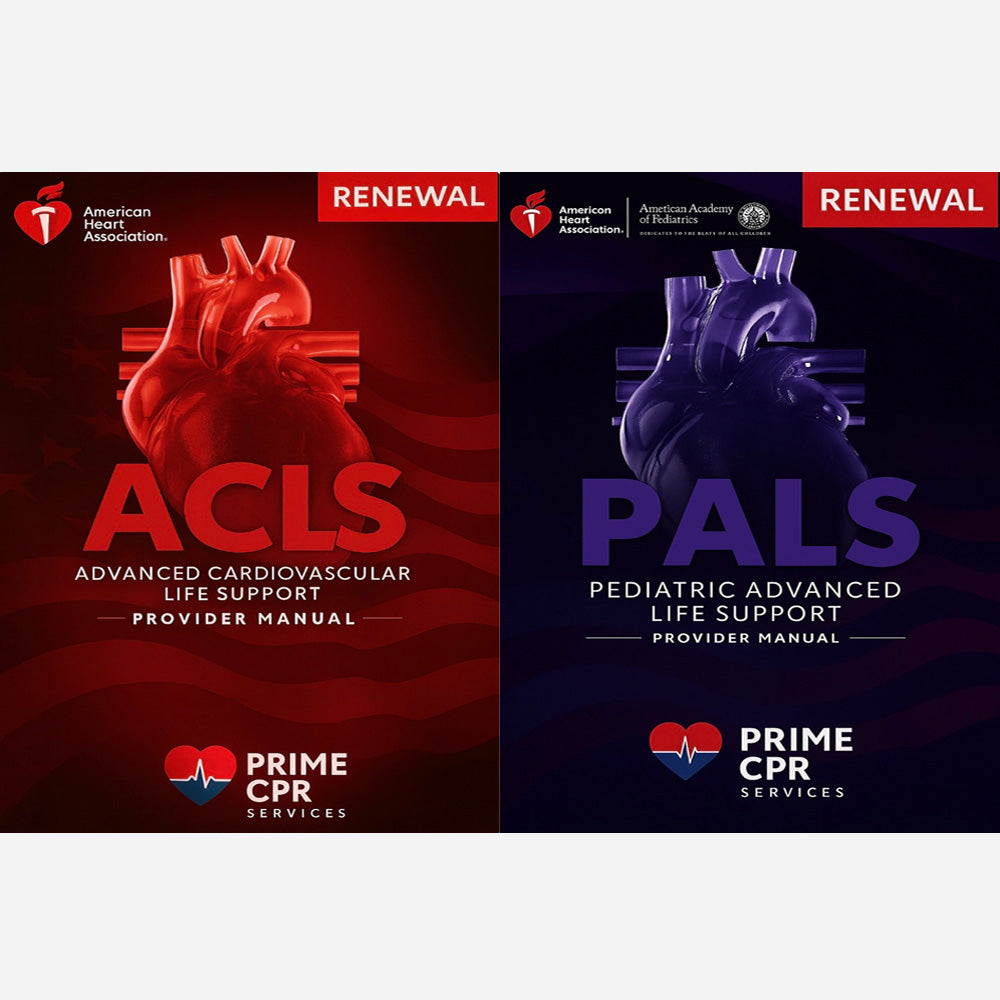
Prime CPR Services offer this combo class of ACLS RENEWAL and PALS RENEWAL to make re-certification a breeze. Get the convenience of comprehensive reviews, comprehensive training materials, and experienced medical professionals in one easy class. Refresh your skills and renew your credentials with this relaxed, stress free course.
Books are shipped priority, so you will get them in plenty of time before your class. You could also purchase the ACLS ebook by clicking HERE and/or the PALS ebook by clicking HERE.

The ACLS RENEWAL course is stress-free and relaxed. It is updated with the latest guidelines from the American Heart Association Guidelines for Cardiopulmonary Resuscitation and Emergency Cardiovascular Care. It is designed primarily for healthcare professionals in emergency departments, intensive care units, critical care departments, surgical areas, or pre-hospital environments, such as physicians, nurses, paramedics, respiratory therapists, and other professionals who may respond to a cardiovascular emergency. You will get your ACLS card right after the class which is valid for 2 years.
ACLS RENEWAL covers the core principles, including:
- BLS Review: Basic Life Support (BLS). 1 and 2 Rescuer High-quality CPR for adults, children, and infants, use of a Bag Valve Mask (BVM), use of an Automated External Defibrillator (AED), and relief of choking.
- Systematic Approach: Assessment, Identification of rhythms, and appropriate interventions. Effective team dynamics, Roles, and Responsibilities during a resuscitation, Management of a patient in cardiac arrest or other cardiovascular emergencies.
- Rhythm Recognition and Scenarios: Ventricular Fibrillation (VF) and Pulseless Ventricular Tachycardia (VT), as well as non-shockable rhythms like Asystole and Pulseless Electrical Activity (PEA). Sinus Bradycardia and Supraventricular Tachycardia (SVT)
- Electrical Therapy: Defibrillation, Cardioversion, and Pacing.
- Pharmacology: Indications, Dosages, and Administration routes of Atropine, Amiodarone, Adenosine, Epinephrine, and Dopamine.
- Post-Cardiac Arrest Care: Critical care following Return of Spontaneous Circulation (ROSC), including targeted temperature management and other post-cardiac arrest interventions.
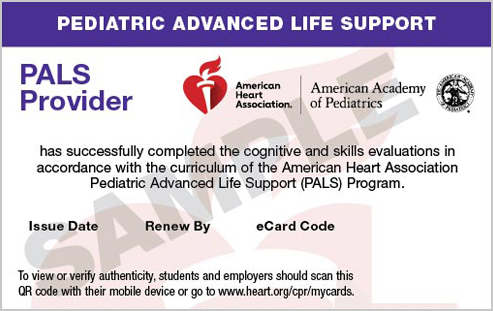
The PALS RENEWAL course is stress free and relaxed. It is updated with the latest guidelines from the American Heart Association. We will explain everything in a way that is easy to understand and remember. It is designed for pediatricians, emergency physicians, family physicians, physician assistants, nurses, nurse practitioners, paramedics, respiratory therapists, and other healthcare providers who initiate and direct advanced life support in pediatric emergencies. You will receive your AHA PALS card right after the course. All cards are valid for 2 years.
The PALS RENEWAL course teaches:
- Pediatric Assessment: Systematically assess pediatric patients, identify potential life-threatening conditions, and prioritize interventions based on the child's condition.
- Basic Life Support (BLS) Skills: High-quality CPR for infants, children, and adults, including chest compressions, rescue breaths, and the use of an AED.
- Pediatric Algorithms: PALS-specific algorithms and flowcharts for managing various pediatric emergencies.
- Respiratory Emergencies: Recognition and management of respiratory distress, failure, and arrest in pediatric patients.
- Cardiac Arrest Management: Steps to manage cardiac arrest in infants and children, including medications, defibrillation, and advanced airway management.
- Vascular Access: Techniques for obtaining vascular access in pediatric patients.
- Pharmacology: Indications, dosages, and administration of medications used during pediatric resuscitation.
- Bradycardia and Tachycardia Management: Identify and manage various heart rhythms in pediatric patients.
- Post-Cardiac Arrest Care: Critical care following successful resuscitation.
- Team Dynamics: Effective communication and teamwork during pediatric emergencies.
Feel free to call, text, or email us if you have any questions or concerns.